
Corporate Governance / Malta 2026
Malta Beneficial Ownership Changes in 2026: Does Your Company Need Form BO4?
Malta’s beneficial-ownership rules changed in July 2026. Work through the simplified-regime conditions, identify the relevant BO4 transition and keep the assessment separate from annual confirmations and later ownership changes.

What to know before you decide
- Companies within the rules formed before 10 July 2026 must assess whether the simplified approach applies. The six-month transition has a calendar endpoint of 10 January 2027.
- All four simplified-regime conditions must hold. A register listing only individuals is not sufficient evidence by itself.
- Where the simplified approach applies, the register of members serves as the beneficial-owners register and the specified separate BO reporting is disapplied while the conditions continue.
- BO4, changes in beneficial ownership and annual BO confirmation address different events. An ordinary company annual return remains a separate obligation.
A Maltese company’s shareholder list is a starting point for understanding beneficial ownership. It does not always show who ultimately owns the economic interest or controls the decisions.
The 2026 amendments make that distinction especially relevant. They introduced Form BO4, additional identifying particulars and a simplified approach for qualifying structures. The practical question for directors is whether the company meets every condition for that approach and what the conclusion means for its filings.
For companies within the rules that were formed before 10 July 2026, the current consolidated text requires an assessment within six months of that date. The calendar endpoint is 10 January 2027. That assessment does not mean every company must file BO4. S1
Start with the current rules
Legal Notice 184 of 2026 introduced the July changes. The consolidated regulations now also incorporate Legal Notice 226 of 2026, including the wording that identifies companies formed before 10 July for the transitional assessment. Use the current consolidation when reviewing the position; a July announcement alone does not show every subsequent correction. S1 S2
First establish that the entity falls within these regulations. There is, for example, a specific exclusion for certain listed companies and companies indirectly fully owned by qualifying listed companies. The rules also extend, with the necessary adaptations, to specified commercial partnerships. S1 S3
For an ordinary private company, the useful output is a recorded conclusion covering:
- The ownership and control facts.
- Whether all simplified-regime conditions are met.
- The transitional form and ongoing notices, if applicable.
- The evidence, responsible officer and completion date.
The four conditions work together
The simplified approach under the first proviso to regulation 5(3) depends on all four limbs being satisfied.
| Condition | What the company needs to establish |
|---|---|
| Individual shareholders | Every registered shareholder is a natural person. |
| No fiduciary holding | None of those individuals holds the shares as trustee or in another fiduciary capacity. |
| No undisclosed ultimate owner or controller | No person outside the register of members ultimately holds the relevant ownership or voting interest, or controls the company through other means. |
| Senior-managing-official limb | The beneficial-ownership analysis does not require identification through the senior-managing-official fallback. |
The ownership limb refers to more than 25% of voting rights or other ownership interests, while also capturing control through other means. These are cumulative tests for the simplified approach, rather than a choice between four alternatives. S1
Where the approach applies, the register of members is treated as the beneficial-owners register. MBR explains that the relevant separate BO declarations and notices are then inapplicable, and its guidelines confirm that annual BO confirmation is disapplied while the conditions remain satisfied. S2 S3
“Senior managing official” needs careful interpretation
The reference to senior managing officials can easily be misunderstood. It does not mean that a company fails simply because it has an employee called a manager or a director who runs the business.
The beneficial-owner definition in Malta’s money-laundering regulations provides a fallback when all possible means have been exhausted, no beneficial owner has been identified and there are no grounds for suspicion. In that situation, the relevant senior managing official or officials are identified, and the search and difficulties must be recorded. S4
BO4’s prescribed wording reflects this distinction: it offers a section for identified beneficial owners and a separate section for the senior-managing-official position, with an explanation of why those officials have been identified. S1
An incomplete ownership file is not a reason to choose the chief executive and stop asking questions. Establish the underlying facts first. Where the evidence is inconsistent or creates suspicion, escalate the issue through the appropriate professional process.
Three hypothetical structures
These examples illustrate the assessment. They assume an existing private company within the regulations and no additional facts that change the analysis.
1. Two individuals hold the shares for themselves
Mara and Daniel are registered as equal shareholders. Each holds the economic interest for themselves, neither acts in a fiduciary capacity, no other person controls the company and the beneficial owners can be identified without the fallback.
On those assumptions, the simplified conditions are met. The company should record its assessment and maintain the supporting register. It should review the conclusion if an ownership, voting or control arrangement changes.
2. One registered shareholder acts for another person
Mara and Daniel still appear as equal shareholders, but Mara holds her shares as nominee for Elena.
The visible register has not changed, yet the fiduciary and undisclosed-interest questions produce a different result. The structure cannot be treated as simplified merely because both registered shareholders are individuals. The record must identify the relevant underlying ownership and the nominee arrangement, and the applicable BO4 position must be addressed.
3. No one exceeds the percentage threshold
Four people each hold 25%, with no different voting allocation identified.
That arithmetic does not, by itself, prove that the company has no beneficial owner. The review must examine control through other means, including relevant agreements and appointment rights. If the proper enquiries identify no beneficial owner and the fallback conditions are satisfied, the senior-managing-official position becomes relevant. S4
When does BO4 apply?
Regulation 5(6) addresses an existing company to which the simplified approach does not apply. It requires conformity with the regulations and delivery of the prescribed form, followed by the relevant later notices and declarations. S1
The clear practical case highlighted in MBR’s July notice is a company with only individual registered shareholders that fails one of the remaining conditions. That company should assess and prepare the BO4 filing within the transition. S2
Do not assume that an existing beneficial-ownership filing removes the need for the new assessment. The current regulation is broader in its wording than the natural-shareholder example in the July notice. A company with corporate shareholders, or one already reporting under the ordinary regime, should document its position against the full current text and obtain clarification of the required transitional submission where needed. A company shareholder does not satisfy the first simplified condition.
Set an internal completion date comfortably before the January endpoint. Allow time to resolve contradictory information, obtain identity evidence, secure the officer’s signature and deal with a filing query. The transition should not become a reason to postpone an ownership change that already has its own notification deadline.
Use the form that matches the event
The current MBR forms catalogue separates the following documents. S5
| Event | Relevant document or step |
|---|---|
| Initial 2026 transitional assessment leads to a required declaration | BO4, under regulation 5(6). |
| Beneficial ownership changes in a company outside the simplified approach | BO2, under regulation 6. |
| Company reaches its registration anniversary and annual BO reporting applies | Annual Confirmation BO Form, under regulation 6A(1). |
| The identified senior managing officials change | Change in Senior Managing Officials Form, under regulation 6A(3). |
| Identifying details change | Change in Details of BO/SMO Form, under regulation 6A(4), as applicable. |
For reportable changes under regulation 6(1), the notice is due within 14 days after the change is recorded with the company. The identified-SMO change provision also uses a 14-day period from recording. Annual BO confirmation, where applicable, is due within 42 days after the date to which it is made up. S1
MBR’s annual-filings guidance separately identifies the company annual return and the annual beneficial-ownership confirmation where applicable. A company eligible for the simplified BO approach should therefore keep its ordinary corporate annual-filing calendar. S6
Update the evidence before filling the boxes
The amendments expanded the information to include place of birth, residential address and relevant nominee-shareholder information, alongside existing identity and ownership particulars. They also reinforced the need to identify control beyond registered shareholding. S3
Prepare the record in four layers:
The structure. Reconcile the register of members with the constitutional documents, share movements and voting arrangements. Trace any indirect holdings to the relevant individuals.
The control arrangements. Review shareholder agreements, nominee or trust documents and rights over appointments or decisions. Record why a particular right does or does not establish ultimate control.
The people. Check names, identification details, nationality, residence and the new particulars against suitable evidence. Resolve differences in spelling or dates rather than copying inconsistent information into separate forms.
The history. Record when a person became or ceased to be a beneficial owner, or when the nature or extent of the interest changed. This supports both the internal record and the correct event-based filing.
Use MBR’s current forms catalogue when preparing the submission. Its July notice states that the amended forms apply immediately and that older versions are not valid. S2 S5 Keep the filed version and acknowledgement with the assessment.
Discuss the wider corporate-records structure through Corporate & Fiduciary.
Give the review a clear owner
Ask a director or the company secretary to coordinate the exercise, with suitable professional input where ownership or control is complex.
The final file should enable another responsible person to understand the conclusion without repeating the entire investigation. It should show the questions asked, documents considered, unresolved points, decision, applicable filing and evidence of completion.
Frequently asked questions
Must every Maltese company file BO4?
No. First establish scope and assess the simplified conditions. Companies meeting all of them have the relevant separate BO reporting disapplied while that position continues. Companies outside the simplified approach must address the current transitional requirements; prior filings alone should not be treated as an exemption. S1 S3
Does a managing director automatically prevent simplification?
No. Distinguish an ordinary job title from identification under the beneficial-ownership fallback. The fallback follows the required ownership-and-control enquiries and is subject to the conditions in the beneficial-owner definition. S4
Can a company wait until January to report a new beneficial owner?
The transition does not replace an existing event-based deadline. Where regulation 6(1) applies, the notice is due within 14 days after the change is recorded with the company. Coordinate the change filing and BO4 assessment as separate tasks. S1
Who signs BO4?
The prescribed form provides for signature by a director or the company secretary. The signatory should have the supporting assessment and verified particulars, including the explanation where senior managing officials are identified. S1
What about a company formed on or after 10 July 2026?
It should follow the current incorporation and beneficial-ownership requirements. The transitional assessment for pre-existing companies is not a general six-month permission to leave a new company’s ownership information unresolved. S1
Make the filing follow the assessment
A useful October action is to assign the review, reconcile the ownership evidence and record the applicable filing position. KMFINCO’s Corporate & Fiduciary service is the relevant starting point for discussing the company’s records, responsibilities and next steps.
General information checked on 7 October 2026. The assessment depends on the current rules and the company’s actual ownership and control arrangements.
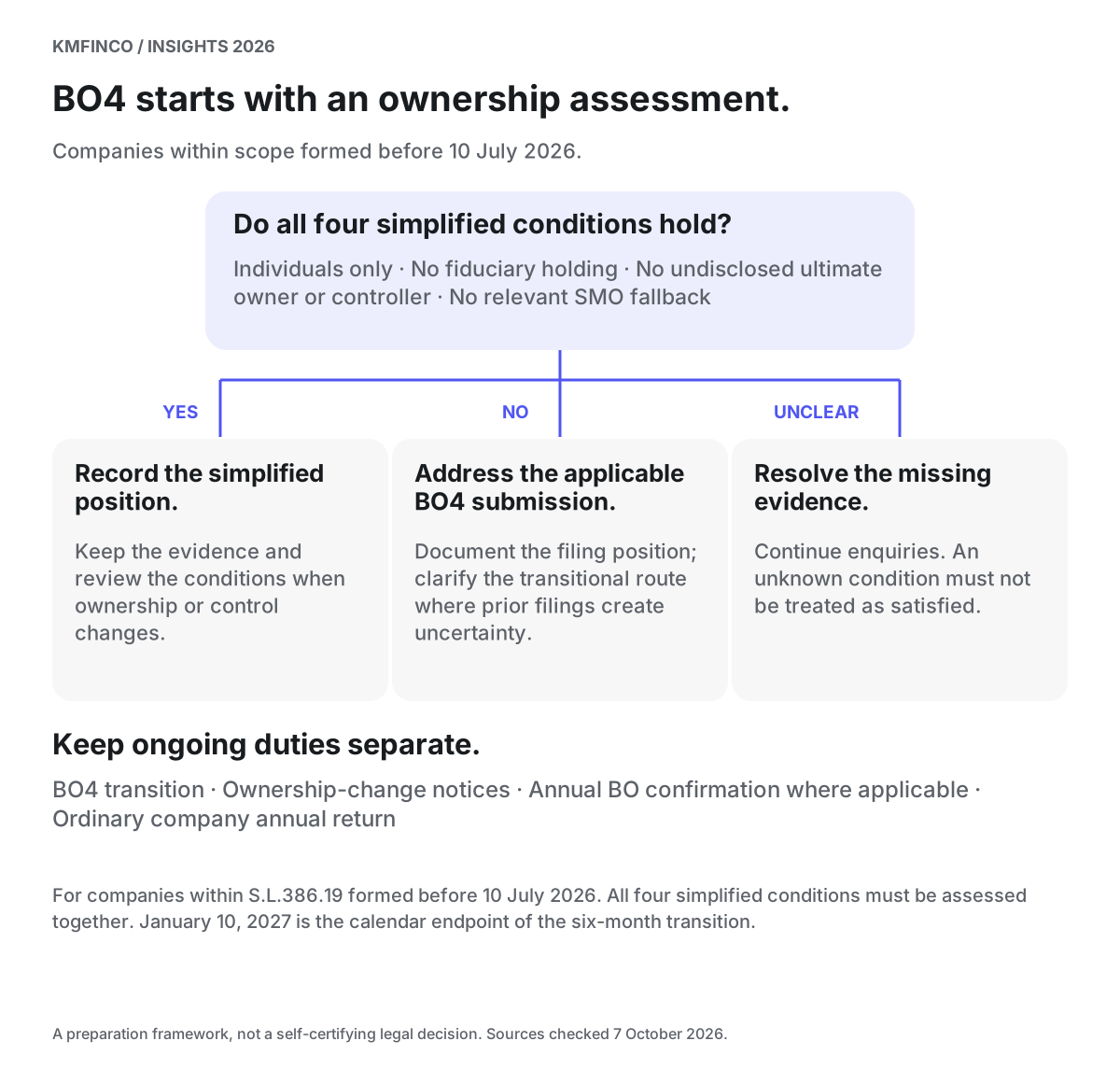
First establish the facts. For a company within scope formed before 10 July 2026, assess all four simplified conditions together.
- If all four hold: record the simplified position, maintain the evidence and review changes.
- If a condition fails: address the applicable BO4 submission and clarify the transitional route where prior filings create uncertainty.
- If a condition is unclear: continue enquiries; do not treat missing evidence as satisfaction of the condition.
Keep BO4, ownership-change notices, annual BO confirmation where applicable and the ordinary annual return separate.
Read the figure as text
First establish the facts. For a company within scope formed before 10 July 2026, assess all four simplified conditions together.
- If all four hold: record the simplified position, maintain the evidence and review changes.
- If a condition fails: address the applicable BO4 submission and clarify the transitional route where prior filings create uncertainty.
- If a condition is unclear: continue enquiries; do not treat missing evidence as satisfaction of the condition.
Keep BO4, ownership-change notices, annual BO confirmation where applicable and the ordinary annual return separate.
BO4 assessment and evidence checklist
An original internal preparation record for directors and company secretaries. It does not replace the prescribed form or establish eligibility by itself.
Open the checklist Print-friendly checklistSources and further reading
- [S1] Companies Act (Register of Beneficial Owners) Regulations — S.L.386.19, current consolidationIncludes LN184 and LN226 of 2026; regulation 5(3) corrected pre-10-July scope and four simplified conditions; 5(6) transition; 6 and 6A notices, annual reporting and deadlines; current prescribed BO4.
- [S2] MBR — Informative Note: Entry into force of legislationLN184 commenced 10 July; six-month transition; highlighted affected natural-shareholder companies; current forms required immediately.
- [S3] MBR — User Guidelines: Companies Act (Register of Beneficial Owners) (Amendment) Regulations, 2026Simplified conditions; expanded particulars; control enquiries; annual-confirmation disapplication while conditions hold; partnerships and applicability.
- [S4] Prevention of Money Laundering and Funding of Terrorism Regulations — S.L.373.01, regulation 2Beneficial-owner definition, relevant ownership thresholds, other means of control, and senior-managing-official fallback after all possible means and absent suspicion.
- [S5] MBR — Official Registry FormsForm names and event mapping: BO4, BO2, annual confirmation, change in SMO and change in identifying details.
- [S6] MBR — Annual FilingsDistinction between the company annual return and annual BO confirmation where applicable.