
Audit & Assurance / Malta 2026
Malta Audit Exemptions in 2026: Audit, Review Report or Neither?
A practical guide to Malta’s separate company-size and audit-exemption tests, the tax review-report route, and the evidence directors should assemble before changing their reporting arrangements.

What to know before you decide
- Small-company classification and audit exemption use different tests. Turnover below €10 million is not a general exemption from audit.
- An eligible company may still need an ISRE 2400 review for tax purposes even when a Companies Act audit exemption applies.
- The reporting period, previous periods and any relevant group position can change the answer.
- Agree the required accounts, report, declarations and filing responsibilities before changing the engagement.
A Malta company may qualify for an exemption from statutory audit and still need a professional review report for tax purposes. Another may be exempt from both reports under the relevant tax route. Neither conclusion follows simply because the business is described as small.
For directors, the useful starting point is a short reporting assessment that connects the company, its accounting period and its legal obligations. That assessment should precede any decision to cancel an audit, commission a review or change what is filed.
This guide covers the ordinary private-company route as understood on 7 October 2026. It is general information; the company's facts and applicable requirements determine its reporting position.
Start with three separate questions
What accounts must the company prepare? What assurance is required? What must be delivered, and to whom? These questions are related, but answering one does not resolve the others.
Malta's Audit Exemption Rules recognise specified exemptions for income-tax purposes without removing audit obligations imposed under other legislation. MTCA's guidance expressly preserves that distinction. S3
Use a reporting matrix with a separate line for the Companies Act, income-tax requirements and any additional sector or contractual obligation. For each line, identify the relevant period, required document, intended recipient and person responsible. This makes a disagreement about “whether we need an audit” easier to resolve: the parties may be discussing different obligations.
The question is particularly relevant to current compliance work. MTCA's YA2026 company-return announcement identifies additional wording dealing with the Audit Exemption Rules. The reporting assessment therefore needs to connect with the return actually being prepared. S6
Do not mix the two threshold sets
Article 185 contains different figures for different purposes. The distinction should remain visible in any briefing to the board.
| Test | Balance-sheet total | Net turnover | Average employees | Purpose |
|---|---|---|---|---|
| Article 185(1) | €5,000,000 | €10,000,000 | 50 | Small-company classification under the relevant provisions |
| Article 185(2) | €46,600 | €93,000 | 2 | Separate private-company audit-exemption criteria |
The statutory tests use limits that are not exceeded, and involve at least two relevant criteria. Article 185 also addresses changes across accounting periods and parent-company circumstances. S1
A director should therefore be wary of an assessment that starts and ends with annual sales. Ask which paragraph is being applied, where the balance-sheet and employee figures came from, and which other conditions have been checked.
Establish the reporting period before using the 2026 figures
MBR states that the revised company-size thresholds apply to financial reporting periods starting on or after 20 March 2026. It prohibits early or retrospective application. S2
For example, an ordinary calendar-year period beginning on 1 January 2026 began before that date. A twelve-month period beginning on 1 April 2026 began after it. The date on which the accounts are signed or the adviser reads this article does not change those start dates.
There is another commencement date to keep separate: the ordinary tax route in rule 6 applies to accounting periods commencing on or after 1 January 2025. The Audit Exemption Rules were enacted in 2025; they are not a new general audit waiver introduced for all companies in 2026. S4
Write the accounting-period start, period end and year of assessment at the top of the working paper. This small administrative step prevents advice intended for one period from being carried into another.
How the ordinary tax route works
For an eligible company benefiting from the Article 185(2) exemption, MTCA's guidance distinguishes two outcomes. Meeting two relevant criteria can permit a review report in place of the statutory audit report for the specified tax requirement. Meeting all three can permit exemption from both reports. The guidance illustrates the assessment over consecutive periods and in group situations. S3
If the company does not establish that it qualifies, it should not replace its existing audit arrangement on the strength of a threshold calculation alone. First resolve the missing facts and the applicable route.
The history matters. The rules refer to Article 185(3), which addresses changes over two consecutive accounting periods after the first balance-sheet date. A first period requires its own assessment; “every company must have traded for two years before any exemption” is not an accurate universal shortcut. S4
Two illustrative companies: the employee figure changes the question
The following companies are fictional. Assume each is an ordinary Malta private company, has no relevant group or sector complication, has unchanged circumstances over the two periods shown, and satisfies the other conditions for the ordinary route. These examples explain the comparison; they are not individual eligibility determinations.
| Company and measure | Previous period | Current period |
|---|---|---|
| Harbour Studio: balance-sheet total | €32,000 | €39,000 |
| Harbour Studio: net turnover | €72,000 | €87,000 |
| Harbour Studio: average employees | 3 | 3 |
| Island Desk: balance-sheet total | €29,000 | €36,000 |
| Island Desk: net turnover | €68,000 | €84,000 |
| Island Desk: average employees | 1 | 2 |
Harbour Studio stays within the asset and turnover limits but exceeds the employee limit in both periods. Its file points towards the review-report route, assuming the stated eligibility conditions hold. Calling it completely exempt would overlook the third measure.
Island Desk stays within all three limits in both periods. Its file points towards the route with neither audit nor review for the specified tax requirement, again subject to the assumptions. The distinction is consistent with MTCA's published framework. S3
Now change one fact: suppose Island Desk has just acquired a subsidiary. The figures above no longer provide a complete assessment. The structure and relevant group conditions must be examined before the earlier conclusion is carried forward. Likewise, a single current-year movement should be assessed against the applicable transition rule, rather than treated as an automatic switch.
Group circumstances and special routes need their own assessment
A parent company's standalone balance sheet may tell only part of the story. Where the relevant consolidation requirement applies, rule 6(2) links the relief to the group's continuing small-group qualification. Establish the structure, the applicable consolidation position and the correct period-specific figures. S4
Ask for the ownership chart and the subsidiaries' financial information early. Missing group records discovered just before a filing deadline can turn a simple engagement into an urgent reconstruction exercise.
There are also separate provisions for qualifying newly registered companies and companies under the Merchant Shipping Act. MIA's guidance discusses those routes separately. A newly formed business or a company connected with shipping should not assume that its description establishes eligibility. S5
What a review report actually provides
An ISRE 2400 review is a limited-assurance engagement. It involves less extensive procedures than an audit and does not express an audit opinion. It is still professional assurance work with an evidence-supported conclusion. S7
From a director's perspective, the engagement discussion should establish the financial statements being reviewed, their reporting framework, the information required and the report's intended users. “Review” should not be understood as a quick editorial check of accounts already prepared.
A tax-purpose report may also have a restricted audience. MIA recommends a restriction-of-use paragraph where the review is undertaken solely for MTCA and the report is not intended for general use. Before forwarding it to a lender or investor, check its terms and that recipient's actual requirement. S5
Turn the conclusion into an orderly year-end plan
A useful assessment ends with an agreed sequence of work. Assemble the period dates, reconciled financial figures, employee calculation, earlier reporting position, ownership structure and any additional reporting commitments. Record where each item came from and who confirmed it.
Then agree the engagement and filing plan. Specify who prepares the accounts, who performs any assurance work, which declarations accompany filings, and who checks acceptance. Keep the company's board approval and the practitioner's reporting responsibilities clear.
MIA confirms that the Audit Exemption Rules do not change the applicable financial-statement preparation framework. An exemption should therefore trigger a revised reporting plan, rather than the abandonment of the accounting process. S5
Use the same plan to anticipate growth. If hiring, an acquisition or a change in activity may alter next year's position, budget for the assessment and records needed. Good bookkeeping remains valuable when a company moves between assurance levels.
Frequently asked questions
Does turnover below €10 million mean no audit is required?
No. That figure belongs to the small-company classification shown above. The private-company audit exemption and tax reporting route require a separate assessment.
Can we use last year's conclusion again?
Use it as a starting point, then update the facts. Confirm the period, figures, structure and relevant changes. Record why the previous conclusion continues to apply or why it changes.
Can an eligible company still choose assurance?
Yes, but agree its purpose and audience first. A lender's requirement, an investor discussion or a planned transaction may justify a separate engagement. Confirm exactly what the recipient needs before commissioning work.
Is this the same as internal audit?
No. This guide concerns assurance and reporting connected with financial statements and tax records. Internal audit planning addresses a separate programme of work on governance, risk and controls.
Bring the facts to the reporting discussion
The most productive first conversation starts with the company's records and reporting period. KMFINCO's Audit & Assurance and Tax, Accounting & Payroll service areas provide the relevant starting points for discussing the assessment and resulting work.
Organise reporting responsibilities and supporting evidence with the relevant Audit & Assurance and Tax, Accounting & Payroll specialists.
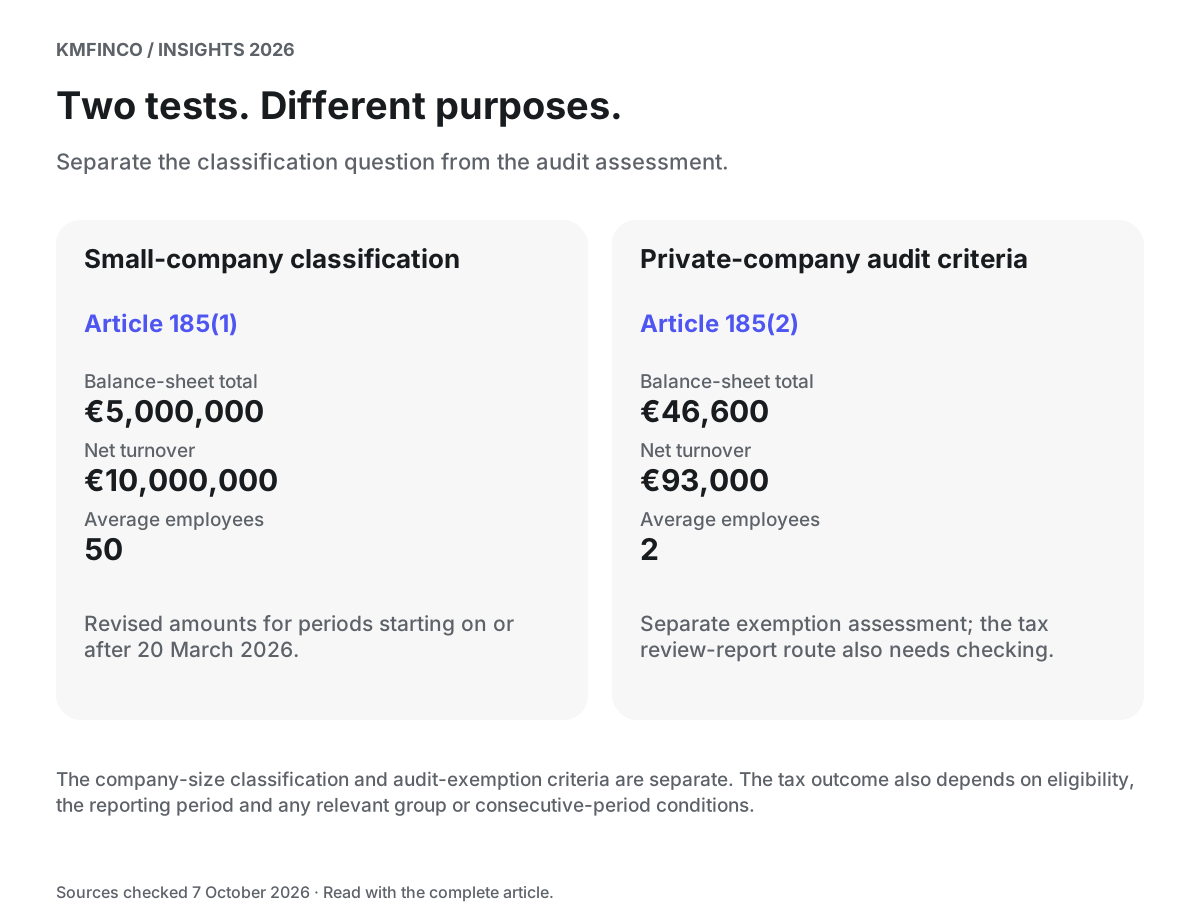
- Small-company classification
Article 185(1) €5m assets · €10m turnover · 50 average employees Classification; revised amounts for periods starting on or after 20 March 2026
- Private-company audit criteria
Article 185(2) €46,600 assets · €93,000 turnover · 2 average employees Separate exemption assessment; consider the ordinary tax review-report route
Read the figure as text
- Small-company classification
Article 185(1) €5m assets · €10m turnover · 50 average employees Classification; revised amounts for periods starting on or after 20 March 2026
- Private-company audit criteria
Article 185(2) €46,600 assets · €93,000 turnover · 2 average employees Separate exemption assessment; consider the ordinary tax review-report route
Prepare your audit-or-review assessment
Bring this evidence to the reporting discussion. It supports an assessment; it does not establish eligibility by itself.
Open the checklist Print-friendly checklistSources and further reading
- [S1] Companies Act, Chapter 386, Article 185Separate Article 185(1) and 185(2) thresholds; periods, definitions and group provisions.
- [S2] MBR: Informative Note – Entry into force of legislationRevised size thresholds apply to periods starting on or after 20 March 2026; early or retrospective application prohibited.
- [S3] MTCA: Guidelines in relation to the Audit Exemption RulesInteraction with other laws, ISRE 2400 review definition, two/three criteria, consecutive-period and group examples.
- [S4] Legal Notice 139 of 2025: Audit Exemption RulesRule 6 commencement, ordinary route, consolidation condition, separate routes and Article 185(3) interaction.
- [S5] MIA: Guidance Note on Audit Exemption, version 1.0Separate routes, continuing financial-statement preparation, review purpose and recommended restricted use.
- [S6] MTCA: Year of Assessment 2026 – Tax Return for CompaniesYA2026 return wording explicitly addresses Audit Exemption Rules.
- [S7] IAASB: Revised standard on review engagementsISRE 2400 review is limited assurance and does not express an audit opinion.