
Private Client Tax / Malta 2026
Malta Tax Residence in 2026: What Changes on 1 January 2027?
Malta’s Individual Tax Programme starts in January 2027. Understand the transition dates, the new financial requirements and the evidence existing beneficiaries and prospective applicants should organise before making a decision.

What to know before you decide
- The Individual Tax Programme begins on 1 January 2027. Its transition provision covers relevant statuses granted, and applications received, by 31 December 2026.
- The continuation horizon is 31 December 2031, subject to the applicable conditions. An application received before the cutoff is not an approval.
- Under the new rules, global and EU/EEA/Swiss categories have a €35,000 annual minimum tax. Pensioner categories have different treatment.
- Establish the tax programme, immigration route, income profile and qualifying-property position together before committing to a move.
Malta’s Individual Tax Programme comes into force on 1 January 2027. For people who already hold a relevant special tax status, or are considering an application during 2026, the immediate task is to establish which framework applies and what must be completed before year-end.
The transition provision covers relevant statuses granted and applications received by 31 December 2026, with continuation until 31 December 2031, subject to the rules. Those dates create a planning window. They do not make an incomplete application acceptable or guarantee that a person qualifies. S1
A useful decision starts with the applicant’s circumstances: current status, nationality, family, income, property and intended pattern of living. The percentage tax rate comes later.
First, separate three different questions
“Malta residence” can describe different legal and practical positions.
| Question | What determines the answer? |
|---|---|
| Am I tax resident in Malta? | The facts of residence, including presence and personal circumstances. |
| Do I qualify for a special tax programme? | The programme’s eligibility conditions and the tax authority’s approval. |
| May I live or work in Malta? | The applicable immigration, residence-registration and employment arrangements. |
MTCA explains that tax residence is a question of fact and that a person may also be tax resident elsewhere. Spending more than 183 days in Malta is one relevant test; someone arriving to establish residence may become resident from arrival. A day count alone does not resolve every case. S2
The immigration process is connected but separate. Identità’s current guidance, for example, describes a residence-permit application for qualifying third-country nationals following confirmation under a relevant programme. EU/EEA/Swiss nationals follow a different registration framework. Special tax status does not itself confer citizenship. S4
For a family planning a move, record each answer separately. This helps prevent a property purchase, school decision or employment commitment from being based on the wrong type of approval.
The dates that matter
| Date | What it means for planning |
|---|---|
| 31 December 2026 | Cutoff specified for relevant status grants and applications received under the transition provision. |
| 1 January 2027 | Commencement of the Individual Tax Programme Rules, 2026. |
| 31 December 2031 | Continuation horizon stated for the transitional population, subject to the applicable conditions. |
Rule 3(3) establishes the transition and the new five-year status cycle, with further five-year renewals available on application. S1
The transition should be assessed against the person’s actual grant and programme. It should not be advertised as a promise that every historic financial condition, fee or property arrangement is frozen in every situation. Equally, an existing beneficiary should not simply assume that the new €35,000 minimum automatically replaces the terms of their current status.
For context, MTCA’s published Global Residence Programme guidance describes a €15,000 annual minimum for that existing programme. That is a programme-specific figure, rather than a general minimum for every person resident in Malta. S3
Ask for a written comparison that identifies the present rules, the transition relied upon, any proposed change of category and the position expected after 2031.
Choose the starting point that matches you
You already hold special tax status
Find the original grant, subsequent correspondence and the most recent annual compliance records. Confirm the precise programme and who is included in the approved household.
Then identify changes since approval: a different property, a dependant’s circumstances, a new source of income, altered travel patterns or a change in immigration status. Those changes may be more consequential than the headline reform.
Your immediate output should be a short status note: what you hold, why the transition applies, the conditions you must continue to meet and the next review date. Keep routine filings and payments on the calendar while that review takes place.
You are preparing a 2026 application
Start with eligibility and a completeness review through the appropriate authorised registered mandatary. Working backwards from the cutoff is useful only when the documents and facts support the intended route.
The existing GRP procedure illustrates why submission needs care: MTCA checks the application and supporting documents, acknowledges progress through the mandatary and identifies omissions that prevent further processing. S3
Keep evidence of what was submitted and when the authority received it. A draft held by an adviser, an appointment booking or a planned courier collection is not the same evidence as receipt by the authority. Resolve any uncertainty about the status of a submission before relying on the transition.
You are planning a move from 2027
Build the plan around the new framework and your actual category. Compare its annual commitments with your expected income and family spending, then coordinate the immigration and property work.
If relocation is likely to last beyond one status term, include the renewal point in the budget and planning horizon. The first application is only one part of the decision.
What the new programme provides
The new rules create four categories. Their income and minimum-tax treatment must be read with the full eligibility conditions. Applicants must also be non-domiciled in Malta, without intending to establish domicile there within five years of application. S1
| New category | Main treatment of qualifying foreign income received in Malta | Annual minimum tax specified |
|---|---|---|
| Global resident | 15% | €35,000 |
| EU, EEA or Swiss resident | 15% | €35,000 |
| Retired pensioner | 15%, with pension-specific eligibility | €15,000 |
| UN pensioner | Qualifying UN pension or widows’/widowers’ benefit exempt; 15% on other qualifying foreign income | €20,000 on the relevant non-UN foreign income |
The global, EU/EEA/Swiss and retired-pensioner minima are payable in full in the grant and cessation years. Do not assume a late-year approval produces a proportionate reduction. S1
The retired-pensioner category requires the documented pension to be received entirely in Malta and to constitute at least 75% of chargeable income. For the UN category, at least 40% of the relevant pension or benefit must be received in Malta. These are distinct routes, so a pension should be classified before applying a general comparison. S1
Other taxable income covered by rule 5(3) is charged separately at 35%. Classify each person’s income: eligibility as a dependant does not necessarily confer the same tax treatment. S1
Prepare an income schedule by person, country, type, tax year and intended remittance. Separate income from capital transfers and record the evidence supporting that classification. This makes the discussion more useful than a single estimate of the money expected to enter a Maltese bank account.
Property, fees and the annual commitment
The standard new qualifying-property thresholds are €700,000 to purchase or €14,000 annual rent, for property in Malta or Gozo occupied as the beneficiary’s primary residence. The application fee is €8,500, with €2,500 for a renewal application. These administrative fees are non-refundable. S1
There is a specific provision for property purchased by a beneficiary before or up to commencement below the new purchase threshold, with its treatment to be determined through the Commissioner’s guidelines. It should not be converted into a blanket claim that every earlier purchase qualifies. Before relying on it, establish the purchaser, acquisition date, consideration, use and applicable guidance.
A practical budget separates the categories:
- Tax: the relevant annual computation and minimum.
- Property: rent or purchase funding, with acquisition and running costs considered separately.
- Application and administration: official fees and agreed professional fees.
- Living arrangements: insurance, family costs and other commitments.
This prevents an application fee from being mistaken for the programme’s full cost.
Hypothetical illustration: why 15% is not the whole answer
Assume an approved new global-resident beneficiary has €100,000 of foreign income within the 15% treatment, received in Malta. Assume no other taxable income, no relevant double-tax relief and no additional household income.
Fifteen per cent of €100,000 is €15,000. With the €35,000 minimum applying, the amount in this simplified example is €35,000.
If the same assumptions apply to €300,000 of relevant income, 15% is €45,000, above the minimum.
These examples explain how the floor works; they do not assess eligibility or the tax treatment of a particular remittance. A personal comparison must also address foreign-country taxation and available relief.
Turn the decision into a manageable plan
Create one working file with a named person responsible for each outstanding item.
Establish the starting position. Put the tax-status letter, tax numbers, passports and immigration documents together. Record the information still missing rather than treating an assumption as a fact.
Map the household and income. List who will move, who will remain elsewhere, the source of each person’s income and any continuing business responsibilities abroad. Use this to identify questions requiring advice in another jurisdiction.
Check property before commitment. Ask the mandatary to assess the intended property against the applicable programme. Keep the actual deed or lease and evidence of occupancy, rather than relying on a property listing.
Agree the application sequence. Identify documents requiring third-party issuance, certification or translation. Set an internal completion date that leaves time to correct omissions and record receipt.
Plan for continuing compliance. The new rules contain ongoing conditions and cessation provisions covering matters including qualifying property, insurance, representation and relevant residence circumstances. S1 Put the resulting actions into the same calendar as tax filings and payments.
For families, this file should also explain who makes decisions if the principal applicant is unavailable. Discuss roles and longer-term priorities through Investment & Family Office, and relocation considerations through Global Mobility.
Frequently asked questions
Does an application received by 31 December guarantee approval?
No. The transition expressly includes applications received by that date, but the applicant must still qualify. Preserve receipt evidence and address deficiencies through the authorised representative; do not confuse acknowledgement with a grant of special tax status. S1 S3
Does the €35,000 minimum apply to everyone living in Malta?
No. It is the minimum specified for the new global and EU/EEA/Swiss categories. Other programme categories have different treatment, and ordinary Maltese tax residence is a separate analysis. Existing beneficiaries need a review of their own transitional position. S1 S2
Can I keep a property purchased for less than €700,000?
Possibly, but the answer cannot be determined from the purchase price alone. The new rules contain a provision for certain earlier purchases subject to the Commissioner’s guidelines. Check its application to the particular beneficiary and property before relying on it. S1
Is the programme right for someone spending fewer than 183 days in Malta?
A day count does not establish suitability. Tax residence, programme conditions, primary residence, time elsewhere and foreign-country obligations must be considered together. A person’s actual arrangements should support the position taken. S1 S2
Make the next decision with the right facts
Start with a documented comparison of your current position and intended move. KMFINCO’s Tax, Accounting & Payroll and Investment & Family Office teams provide relevant starting points for discussing the tax and family-planning questions and coordinating the appropriate professional input.
General information checked on 7 October 2026. Application outcomes and individual tax treatment depend on the applicable rules and the person’s circumstances.
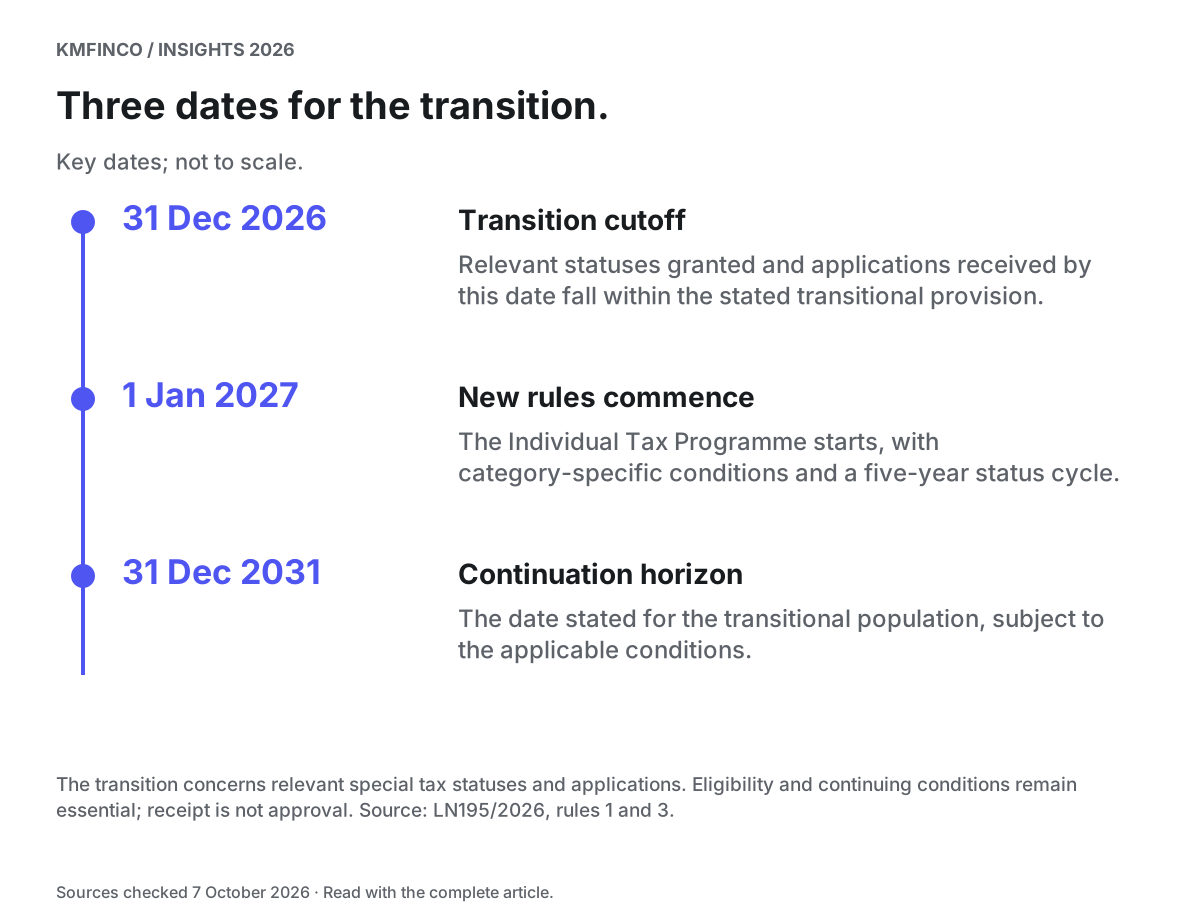
- 31 Dec 2026 — Transition cutoff
Relevant statuses granted and applications received by this date fall within the stated transitional provision.
- 1 Jan 2027 — New rules commence
The Individual Tax Programme starts, with category-specific conditions and a five-year status cycle.
- 31 Dec 2031 — Continuation horizon
The date stated for the transitional population, subject to the applicable conditions.
Read the figure as text
- 31 Dec 2026 — Transition cutoff
Relevant statuses granted and applications received by this date fall within the stated transitional provision.
- 1 Jan 2027 — New rules commence
The Individual Tax Programme starts, with category-specific conditions and a five-year status cycle.
- 31 Dec 2031 — Continuation horizon
The date stated for the transitional population, subject to the applicable conditions.
Your Malta tax-residence preparation record
Use this original planning checklist to organise the facts for a programme assessment. It is not an application form or eligibility certificate.
Open the checklist Print-friendly checklistSources and further reading
- [S1] Individual Tax Programme Rules, 2026 — Legal Notice 195 of 2026Commencement; rule 3(3) transition, duration and renewal; four categories; property definitions; fees; minimum tax; pension conditions; continuing and cessation conditions.
- [S2] MTCA — Tax ResidenceTax residence as a question of fact; presence and arrival to establish residence; possible dual residence; ordinary residence and domicile distinguished.
- [S3] MTCA — Global Residence Programme Guidelines, Version 2.0Existing GRP €15,000 minimum; application through an authorised registered mandatary; completeness checks and acknowledgement process.
- [S4] Identità — Economically Self-Sufficient Residence Permit FAQsSeparate residence-permit process after relevant programme confirmation; different EU/EEA/Swiss process; separate citizenship and MPRP administration.