
VAT / Malta 2026
VAT Registration in Malta in 2026: Article 10, Article 11 or Article 12?
Understand Malta’s domestic small-enterprise threshold, input-VAT trade-offs and cross-border purchases. Three practical examples show why Articles 10, 11 and 12 need to be assessed together.

What to know before you decide
- The domestic SME threshold is €35,000; determine Malta turnover under the VAT rules and monitor it during the year.
- Article 11 removes VAT on covered sales but gives no input-VAT deduction for the exempt activity.
- Article 12 can accompany Article 11; the €10,000 intra-EU goods threshold does not apply to overseas services.
- A registration change requires the applicable conditions and effective date, including the rules for early conversion.
A Malta business can qualify for the small-enterprise exemption on its local sales and still have VAT to pay on services bought from abroad. That is why choosing a registration by turnover alone can leave an important part of the business unexamined.
Article 10 is the normal VAT registration framework. Article 11 concerns the domestic small-enterprise exemption. Article 12 addresses specified cross-border transactions for persons outside Article 10, and can sit alongside Article 11. The practical assessment starts with what you sell, where those supplies take place and what you purchase.
This guide covers the general rules checked on 7 October 2026. Its examples are hypothetical; property, financial services and other special transactions may need separate treatment.
Start with the purpose of each registration
MTCA’s registration guidance distinguishes the ordinary framework, the small-enterprise exemption and the obligations arising from relevant overseas purchases. The following table is an orientation; each supply still needs the correct VAT treatment. S1
| Question | Article 10 | Article 11 | Article 12 |
|---|---|---|---|
| Main purpose | Normal VAT registration. | Small-enterprise exemption for qualifying supplies in Malta. | Specified intra-EU acquisitions and cross-border services outside Article 10. |
| VAT on customer sales | Apply the relevant rate or exemption. | No VAT charged on supplies covered by the exemption. | Does not itself decide the treatment of the business’s sales. |
| VAT on business purchases | Deduction may be available, subject to the rules. | No input-VAT deduction for the exempt activity. | No input-VAT recovery merely because Article 12 VAT is paid. |
| Can it stand alongside Article 11? | The domestic Article 10/11 status is an alternative. | Yes, alongside Article 12 when required. | Yes; it can create an additional obligation. |
The important distinction is between a supply’s treatment and the business’s registration. A normal registration does not make every sale taxable at 18%. Equally, a small-enterprise exemption does not remove the need to examine purchases.
What the €35,000 threshold means in 2026
The domestic small-enterprise threshold is €35,000, with no separate sectoral thresholds. These rules have applied since 1 January 2025. They are relevant in 2026, rather than a new 2026 threshold announcement. The European Commission confirms that Malta provides no transitional excess allowance when the national threshold is crossed. S2
At application, examine the preceding calendar year and whether the current year has already exceeded the limit. Monitor the current year after registration: the test cannot be left until annual accounts are prepared. MTCA’s guidelines explain how to determine eligibility and domestic turnover. S3
“Domestic” means supplies taking place in Malta under the VAT place-of-supply rules. It does not simply mean money received in a Maltese bank account or invoices issued by a Maltese company.
Use a turnover schedule that distinguishes:
- Supplies taking place in Malta from those taking place elsewhere.
- Taxable supplies, relevant exempt supplies and any excluded capital-asset disposals.
- The preceding calendar year from the current year to date.
- Any proportionate turnover that must be included under the related-person rules.
Certain exempt property, financial and insurance transactions can count unless ancillary. Conversely, a supply outside Malta for VAT purposes may not enter the domestic figure. A business with several activities should classify them before adding the numbers. S3
Shared ownership can affect the calculation
For persons other than natural persons applying for or using Article 11, the rules can require proportionate domestic turnover of related persons to be included. The statutory relationship test includes ownership or control above 10%; MTCA’s guidance explains its application and additional anti-abuse considerations. S3
A new company’s own sales ledger may therefore be insufficient evidence of eligibility. Collect the ownership structure and relevant business activities of the owners and connected entities, including indirect interests. Have the required proportions calculated rather than simply adding every connected business’s worldwide revenue.
This deserves attention when a sole practitioner incorporates, two consultants establish a partnership, or an owner separates activities into different companies. A new legal entity should trigger a fresh assessment of the facts; it should not be assumed to create a fresh unqualified €35,000 allowance.
Example 1: a freelancer buying overseas software
Hypothetical facts: a Malta-established freelancer validly uses Article 11 for local work and buys a €100 business software service from a supplier outside Malta. Assume the service is taxable in Malta, the freelancer is liable under the reverse charge and the applicable rate is 18%.
The resulting Maltese VAT is €18. With no input-tax deduction for the exempt activity, the total economic cost is €118: €100 to the supplier and €18 in Maltese VAT. The standard-rate assumption is consistent with Article 19 of the VAT Act. S4
The relevant Article 12 obligation does not wait for overseas services to reach €10,000. That figure concerns the specified intra-EU goods-acquisition threshold. MTCA separately identifies services received from overseas where Malta is the place of taxation and the customer is liable. S1
Before the first purchase, establish the supplier, service type, business use, correct VAT identification and invoice treatment. If a supplier has charged foreign VAT, investigate the invoice rather than assuming that payment settles every Maltese obligation. Keep subscriptions and advertising accounts in the purchase review; small recurring charges can otherwise escape notice.
Example 2: a retailer comparing prices and input VAT
Input-VAT recovery matters, but it is only one part of the commercial comparison.
Hypothetical assumptions: the business is eligible for Article 11; it sells one standard-rated item to a consumer for the same final price of €118 under either scenario; the item costs €60 plus €10.80 VAT; and the Article 10 scenario permits full deduction. All other costs and income tax are excluded.
| Per item | Article 11 | Article 10 |
|---|---|---|
| Final price paid by the customer | €118.00 | €118.00 |
| Sales amount excluding any output VAT | €118.00 | €100.00 |
| Purchase payment including VAT | €70.80 | €70.80 |
| Recoverable purchase VAT | €0.00 | €10.80 |
| Trading margin before other costs | €47.20 | €40.00 |
The ordinary-registration calculation is €100 revenue less €60 net purchase cost. The exempt-business calculation is €118 revenue less €70.80 purchase cost. Input recovery therefore does not, on its own, determine the better margin.
Change the assumptions and the comparison changes. A business customer with recovery rights may evaluate the price excluding deductible VAT. A major equipment purchase changes the input-tax profile. Growth may remove eligibility for the exemption. Model actual customers, prices and costs rather than selecting a registration because one column appears favourable in isolation.
Example 3: services supplied to an overseas business
Hypothetical facts: a Malta consultant supplies €20,000 of general business consultancy to a VAT-identified company in another EU Member State. Assume the general business-to-business place-of-supply rule applies, with no special rule or relevant fixed-establishment complication.
In that fact pattern, the supply takes place where the business customer is established. It does not become domestic Malta turnover simply because the consultant works from Malta. For a person registered under Article 11, supplying qualifying services in another Member State where the recipient alone pays VAT can create an Article 12 registration requirement. S3
Document the customer’s status and the nature of the service. An overseas address alone does not establish the answer, and a service to a private consumer may follow different rules. Identify any recapitulative reporting and invoice requirements associated with the actual transaction. The VAT Act’s registration and place-of-supply provisions provide the legal framework. S4
Where Articles 11A and 11B enter the picture
Cross-border SME exemption is a further question. Article 11A concerns Malta-established businesses seeking the small-enterprise exemption in other Member States. Article 11B concerns businesses established elsewhere in the EU seeking that exemption in Malta. S3
The EU framework requires Union turnover not exceeding €100,000 in both the current and previous calendar years, together with the relevant national thresholds and notification requirements. Exemption starts when the required EX identification and confirmation for the selected Member State are granted. There is also quarterly turnover reporting. S5
The €100,000 ceiling does not replace Malta’s €35,000 domestic test. Nor does a cross-border sale automatically require or qualify for the SME scheme. First determine where and how the transaction is taxed; then assess whether the relevant exemption is available and appropriate.
Switching registration: the 2026 portal change
On 29 May 2026, MTCA announced that requests to change between Article 10 and Article 11 can be submitted through the VAT e-Services portal. It says requests during the first 12 months and afterwards may be subject to different conditions, and that existing VAT obligations must be complied with. S6
The VAT Act contains a specific early-conversion provision: the Commissioner may accept an Article 10-to-11 request where the small-enterprise conditions are satisfied and no input-tax credits were claimed during the Article 10 period. This is a conditional route, not an automatic right to switch at any date chosen by the taxpayer. S4
Before changing invoice settings, establish the effective registration date. Reconcile filed returns, existing obligations and previous input-tax claims; review stock and capital assets with the accountant. Communicate the correct treatment to whoever issues invoices. A submitted portal request and an effective change in registration are different stages of the process.
Four practical questions
If turnover is below €35,000, can I simply issue invoices without VAT?
Establish eligibility and the required registration first. Confirm that the relevant supplies are covered and use the correct effective date. A turnover figure alone does not determine the treatment of earlier invoices or overseas transactions.
Can Article 11 and Article 12 both apply to my business?
Yes. Article 11 can cover qualifying domestic sales while Article 12 creates obligations on specified transactions. The overseas-software example illustrates why the sales and purchase reviews must be connected.
Do I wait until overseas services cost €10,000 before registering?
No. Do not transfer the intra-EU goods-acquisition threshold to services. Analyse where the service is taxable, who owes the VAT and the registration required before the relevant transaction. S1
Does Article 10 let me recover VAT on every expense?
No. Deduction depends on the applicable rules, business use, supporting evidence and any restrictions or exempt activity. The retailer illustration assumes full entitlement for the particular stock purchase; it is not a general rule for every cost. S4
Put the assessment into the monthly routine
A useful VAT review connects registration, sales classification, overseas purchases and turnover monitoring. Give someone responsibility for flagging a new activity, a large order or a foreign supplier before an incorrect treatment becomes routine.
Record the reporting obligations that actually apply in your finance calendar. KMFINCO's Tax, Accounting & Payroll service provides a relevant starting point for discussing the registrations, transactions and records your business needs to examine.
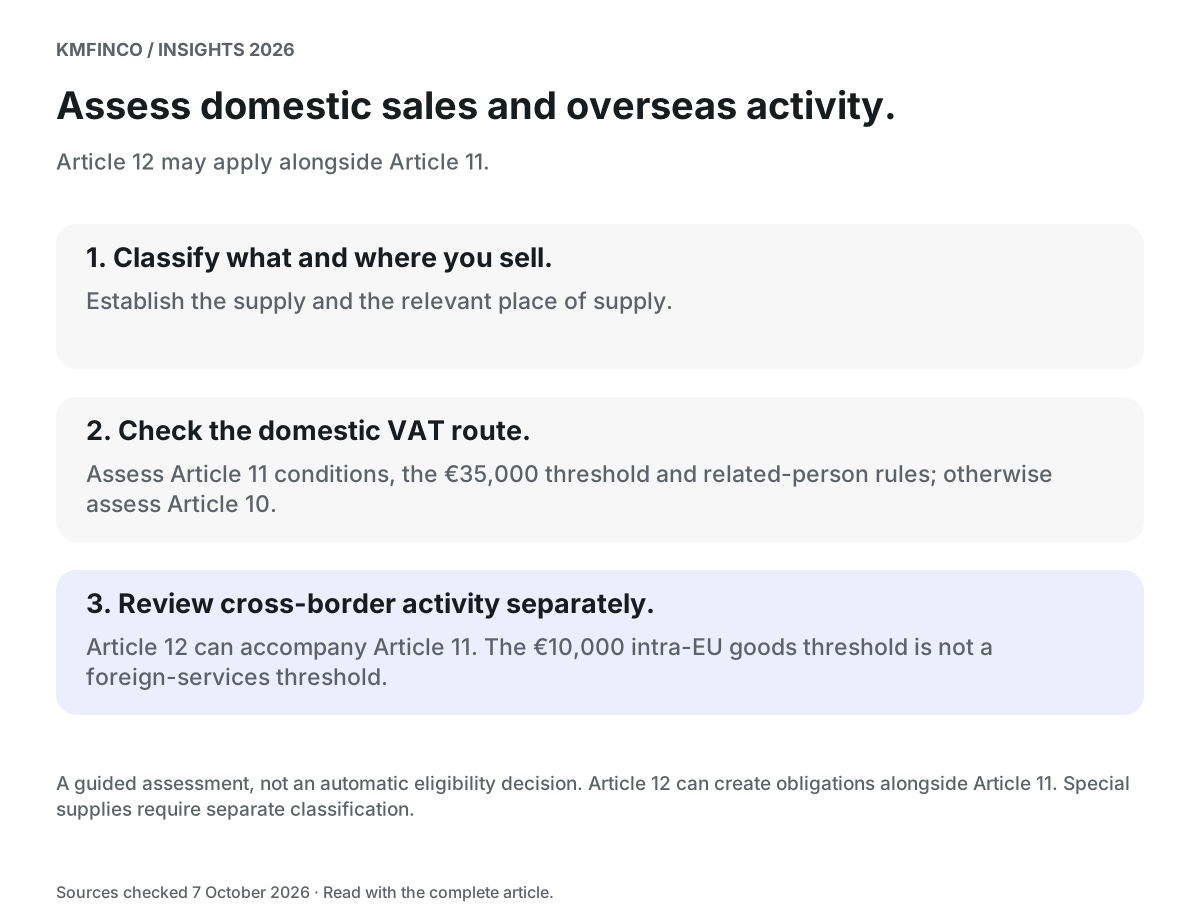
- What and where do you sell?
Classify supplies and establish the relevant place of supply.
- Does the domestic exemption apply?
Check Article 11 conditions, €35,000 domestic turnover and related-person rules; otherwise assess Article 10.
- What do you buy or supply across borders?
Review Article 12 services and goods obligations independently; assess cross-border SME routes where relevant.
Read the figure as text
- What and where do you sell?
Classify supplies and establish the relevant place of supply.
- Does the domestic exemption apply?
Check Article 11 conditions, €35,000 domestic turnover and related-person rules; otherwise assess Article 10.
- What do you buy or supply across borders?
Review Article 12 services and goods obligations independently; assess cross-border SME routes where relevant.
VAT registration and transaction review
Use this original preparation checklist to connect the sales and purchase sides of the business. It is not an official registration form.
Open the checklist Print-friendly checklistSources and further reading
- [S1] MTCA: Registration — Self-Employed, VAT registration under Articles 10, 11 and 12Registration overview, input-VAT distinction and overseas-service obligations where Malta taxation and customer liability apply.
- [S2] European Commission: Malta SME rules€35,000 national threshold, no sectoral thresholds, no transitional excess allowance, domestic and cross-border distinctions.
- [S3] MTCA: Guidelines in relation to the VAT rules applicable to small enterprises2025 commencement, Article 11 eligibility, domestic turnover, exempt transactions, related-person aggregation, Article 12 interactions, Articles 11A and 11B.
- [S4] Value Added Tax Act, Chapter 406, Articles 10–12, 19 and 22; Third and Sixth SchedulesRegistration, place of supply, standard rate, deductions, threshold rules and early Article 10-to-11 conversion provision.
- [S5] European Commission: Cross-border SME scheme€100,000 Union threshold in current and preceding years, national conditions, prior notification, EX confirmation and quarterly reports.
- [S6] MTCA: Changing the VAT Registration TypeVAT e-Services portal requests, timing-dependent conditions and compliance with existing obligations.