
Tax / Malta 2026
Malta’s 15% FITWI Tax in 2026: How It Compares with the Refund System
Compare Malta’s elective FITWI regime with the shareholder-refund system: the tax floor, distribution assumptions, cash-flow timing and five-year commitment that should shape a company’s decision.

What to know before you decide
- FITWI is elective and final, with a statutory floor; 15% is not a universal result for every income stream.
- Compare the company and shareholder together, while keeping their cash flows separate.
- The election commits the entity for five years of assessment, and leaving also has a minimum-period consequence.
- For a 31 December 2025 year-end, the published electronic filing extension is 27 November 2026; payment deadlines are separate.
Malta’s Final Income Tax Without Imputation regime, usually shortened to FITWI, gives qualifying entities an alternative way to be taxed. Its 15% headline is an invitation to compare two systems carefully: the entity’s final liability, the shareholder’s refund position, the timing of cash movements and a commitment extending across several years.
The useful question for a company director is: which framework produces the more appropriate outcome for this business and its owners over the whole commitment period? The answer requires more than comparing 15% with 35%.
This guide explains the general framework checked on 7 October 2026. The examples are hypothetical, with assumptions stated; an election requires a calculation for the particular entity and shareholders.
What FITWI changes
Legal Notice 188 of 2025 created an elective 15% charge on the relevant chargeable income of an eligible entity. Its definition includes companies, certain bodies treated as companies, and specified trusts. The tax is final: it cannot become a shareholder refund or a credit against another person’s Maltese tax liability. Relevant profits are allocated to the final tax account. S1
The ordinary corporate system remains available. MTCA describes a 35% company rate, followed, where the conditions are met, by a refund of part or all of the company tax to shareholders after a dividend distribution. That distinction between the company and its shareholder matters. S2
| Question | Ordinary system | FITWI |
|---|---|---|
| Where does the comparison start? | Company tax calculation, then the relevant shareholder position. | Eligible chargeable income and the statutory floor. |
| Can a shareholder refund arise? | Potentially, subject to the applicable conditions. | No refund of the FITWI tax. |
| What should the cash forecast show? | Company tax, dividends and any later shareholder refund separately. | The entity’s final liability and proposed distributions. |
| What needs a written decision? | The assumed refund entitlement and distribution plan. | Eligibility, the comparative calculation and the commitment. |
Accounting profit is not automatically chargeable income. Begin with the tax computation, including relevant deductions, losses and adjustments, before applying either framework.
The 15% rate has a floor
The regulations prevent FITWI tax from falling below the ordinary-system tax reduced by the shareholder refunds claimed or claimable on the relevant profits, including the adjustment under Income Tax Act Article 43(6), where applicable. A company cannot establish its FITWI liability merely by multiplying an unexamined profit figure by 15%. S1
A practical comparison therefore needs two independently supported calculations. First establish the ordinary-system liability and eligible refunds. Then calculate FITWI and test its floor. A conclusion such as “the shareholders will not submit a refund claim” does not, by itself, settle a rule that also refers to amounts claimable.
Separate excluded income before calculating. The regulations exclude specified dividends from Maltese-company profits not allocated to the distributing company’s final tax account, and income already subject to other final-tax provisions and allocated to that account. Applying 15% to every line in an investment company’s income statement could therefore produce a misleading answer. S1
A worked example: all qualifying profits are distributed
Hypothetical assumptions: a company has accounting profit before tax and chargeable income of €100,000 from ordinary trading; no foreign-tax relief, excluded income or other relevant adjustments; the profits are lawfully distributable and the full after-tax profit is distributed; and the shareholder meets all conditions for a six-sevenths refund. For FITWI, assume eligibility and no floor adjustment above 15%.
Article 48(4A) of the Income Tax Management Act provides the six-sevenths mechanism, with qualifications including the source of the distributed profits, registration and different treatment of certain income. The example assumes those checks have been completed. S3
| Calculation | Ordinary system | FITWI |
|---|---|---|
| Chargeable income | €100,000 | €100,000 |
| Entity tax in this illustration | €35,000 | €15,000 |
| After-tax profit distributed | €65,000 | €85,000 |
| Eligible shareholder refund | €30,000 | €0 |
| Combined company/shareholder Malta tax after refund | €5,000 | €15,000 |
| Total dividend and refund reaching the shareholder | €95,000 | €85,000 |
The refund calculation is €35,000 × 6/7 = €30,000. The ordinary-system amount remaining after that refund is €5,000. Consequently, the assumed FITWI charge of €15,000 is above the floor in this example.
There are two different observations. FITWI involves €20,000 less entity tax initially in this simplified comparison. The ordinary system ultimately leaves €10,000 less combined Malta tax after the assumed refund. Neither observation should be presented without the other.
The table excludes foreign shareholder taxation, financing costs, distribution constraints and processing time. It does not imply that every company qualifies for a 5% effective result, that refunds arrive immediately, or that money refunded to a shareholder automatically belongs to the company.
Retaining profits changes the cash-flow question
Consider a second hypothetical business preparing to fund equipment and recruitment. Its owners intend to retain profits instead of distributing them immediately. A model that puts a future shareholder refund into the company’s bank balance today would overstate cash available for that investment.
Prepare a separate cash schedule for the entity and its owners. Show when tax is paid, when dividends can and will be declared, when a refund could be claimed and received, and whether any shareholder money would be reinvested through a documented transaction. Treat uncertain receipt dates as scenarios, rather than promises.
The FITWI alternative still needs the statutory floor calculation. Retention alone is not a sound basis for assuming an unconditional 15% final cost. Where the meaning or timing of a claimable refund affects that comparison, resolve the treatment in the company’s tax analysis before presenting a cash advantage to the board.
This is also a useful way to evaluate administrative simplicity. Estimate the work the business would actually avoid or retain. Compare that with the difference in tax and financing costs. “Fewer steps” has a value, but the value should be explicit rather than assumed to outweigh every other factor.
Make the decision across five years of assessment
MTCA’s March 2026 notice requires the election through the relevant income-tax-return questions and confirms a binding period of five consecutive years of assessment. S4
For an election beginning with YA2026, the initial five-year span is YA2026–YA2030. The regulations continue the regime until a valid notification to leave; they also impose a minimum five-year ordinary-system period following an exit. There is no annual freedom to switch to whichever regime produces the lowest charge that year. S1
Build one decision paper with five parts:
- Define the entities and income. Identify the taxpayer, owners, tax accounts and income streams. Flag proposed acquisitions, disposals or ownership changes that may alter the assumptions.
- Establish the baseline. Reconcile the latest computation to the financial statements. Support each assumed refund fraction and identify who would receive it.
- Compare the relevant years. Use the known first-period figures and reasonable forecasts for subsequent periods. Test a lower-profit case and a change in dividend policy.
- Map cash separately. Distinguish company liquidity from shareholder receipts. Include a sensitivity for refund timing and financing, without inventing a standard processing period.
- Record the decision and implementation. State the chosen approach, material assumptions, responsible approver and actions needed before filing. Retain the calculation with the tax working papers.
Internationally connected businesses should add a separate review of the owners’ jurisdictions and any relevant group obligations. A Maltese headline rate does not establish the worldwide outcome. The comparison should identify where a foreign-tax conclusion has been confirmed and where it remains dependent on facts.
The 2026 filing point
MTCA made the YA2026 corporate return available in May, including a question about FITWI. This makes the election an operational filing issue, alongside the underlying assessment of suitability. S5
For a company whose financial year ended 31 December 2025, the income normally falls within YA2026. MTCA’s published table gives 27 November 2026 as the electronic-return extension for that year-end. It explicitly says electronic filing extensions do not extend tax-payment deadlines. Other year-ends have different entries in the table. S6
Work backwards from the correct filing date: confirm practitioner access, settle the comparison, obtain approval, complete the return and retain the submission acknowledgement. Check payments on their own timetable. Record dates, responsibilities and supporting evidence in a shared finance calendar.
Questions directors commonly ask
Is FITWI automatically the better choice because 15% is lower than 35%?
No. The 35% figure is the ordinary entity-level starting point. A valid shareholder refund can materially change the combined Malta outcome. Compare both completed calculations and their cash timing, as the worked example illustrates.
Can the business claim a refund of the FITWI tax later?
The regime makes that tax final. The commercial model should therefore show no shareholder refund of the FITWI charge. Any separate tax position outside the illustrated income must be assessed on its own basis. S1
Does every shareholder receive a six-sevenths refund under the ordinary system?
No. The relevant income, tax-account allocation, reliefs, distribution and claimant conditions must be checked. The Act provides different treatment for specified categories, including certain passive interest and royalty profits. The example deliberately assumes one qualifying fact pattern. S3
Can we change the election when our dividend policy changes?
A new dividend policy is a reason to revisit forecasts, but it does not cancel the statutory commitment. Model possible changes before electing and obtain specific advice on any subsequent exit timetable.
Does the November filing extension also delay payment?
No. The cited extension concerns the electronic return. Establish the company’s tax-payment dates separately and verify the filing entry for its actual year-end. S6
Turn the rate comparison into a documented decision
A useful FITWI assessment should leave directors with a clear computation, a cash forecast, a record of the five-year implications and an achievable filing plan. Bring the financial statements, tax workings, ownership information and intended distributions to that discussion.
KMFINCO’s Tax, Accounting & Payroll service is a relevant starting point for discussing your company’s position. Where ownership or distributions require coordination, connect the tax analysis with Corporate & Fiduciary work.
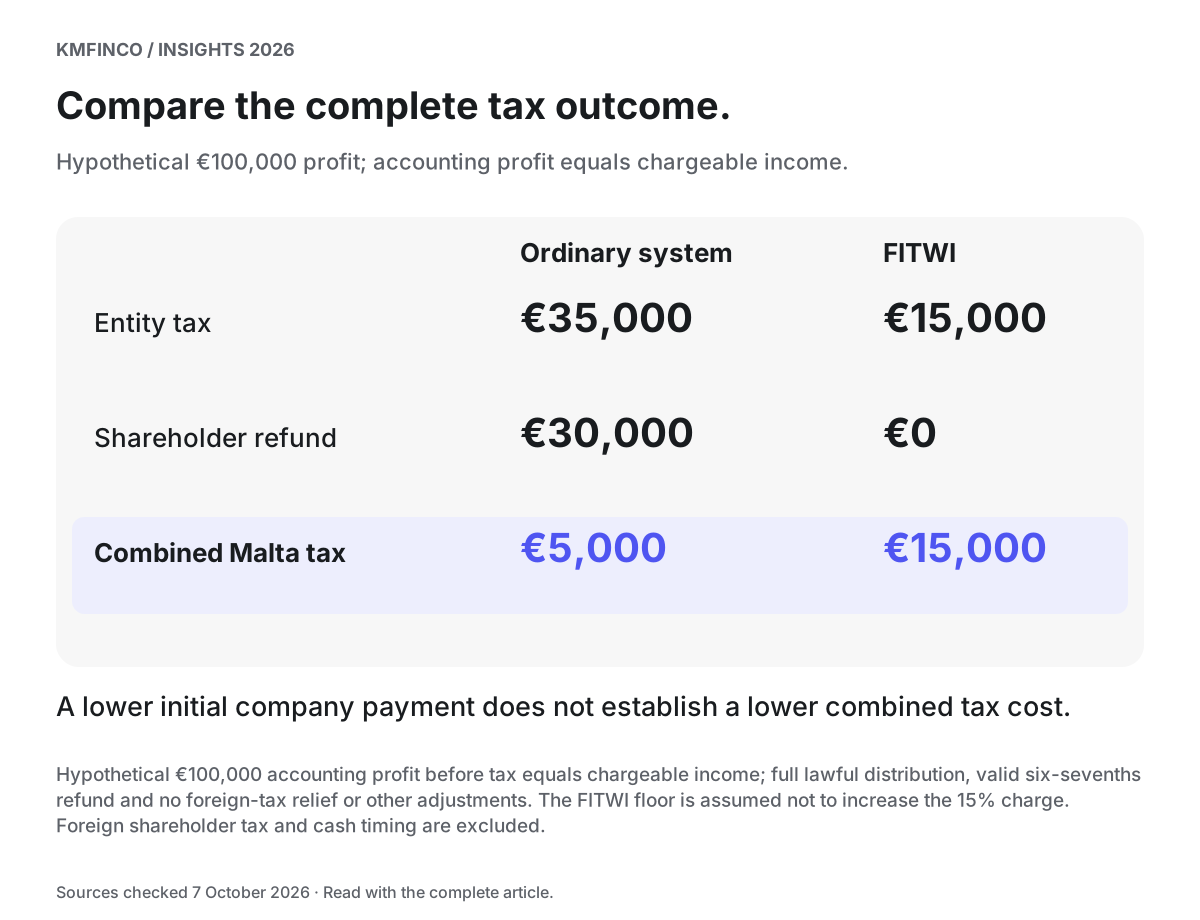
| Illustrative amount | Ordinary system | FITWI |
|---|---|---|
| Entity tax | €35,000 | €15,000 |
| Shareholder refund | €30,000 | €0 |
| Combined Malta tax | €5,000 | €15,000 |
Read the figure as text
| Illustrative amount | Ordinary system | FITWI |
|---|---|---|
| Entity tax | €35,000 | €15,000 |
| Shareholder refund | €30,000 | €0 |
| Combined Malta tax | €5,000 | €15,000 |
FITWI decision file
Prepare one evidence pack before approving an election. This is an original working checklist, not an official filing form.
Open the checklist Print-friendly checklistSources and further reading
- [S1] Final Income Tax Without Imputation Regulations, S.L. 123.217, regulations 2–3Eligible entity definition, elective rate, excluded income, floor, finality, tax-account allocation, continuation and minimum periods.
- [S2] MTCA: Corporate TaxOrdinary 35% company tax and the distribution/refund mechanism.
- [S3] Income Tax Management Act, Chapter 372, article 48(4) and (4A)Refund provisions, six-sevenths mechanism and qualifications used in the expressly hypothetical worked example.
- [S4] MTCA: Election for Final Income Tax Without ImputationElection through the tax return, five consecutive YAs and applicable online deadline.
- [S5] MTCA: Year of Assessment 2026 — Tax Return for CompaniesYA2026 return availability and addition of a FITWI question.
- [S6] MTCA: Income Tax — Company Income Tax Return CycleBasis year/YA distinction, 31 December 2025 year-end electronic filing deadline of 27 November 2026, and exclusion of payment extensions.